
AGENTT

AI-powered project twin for special machine building

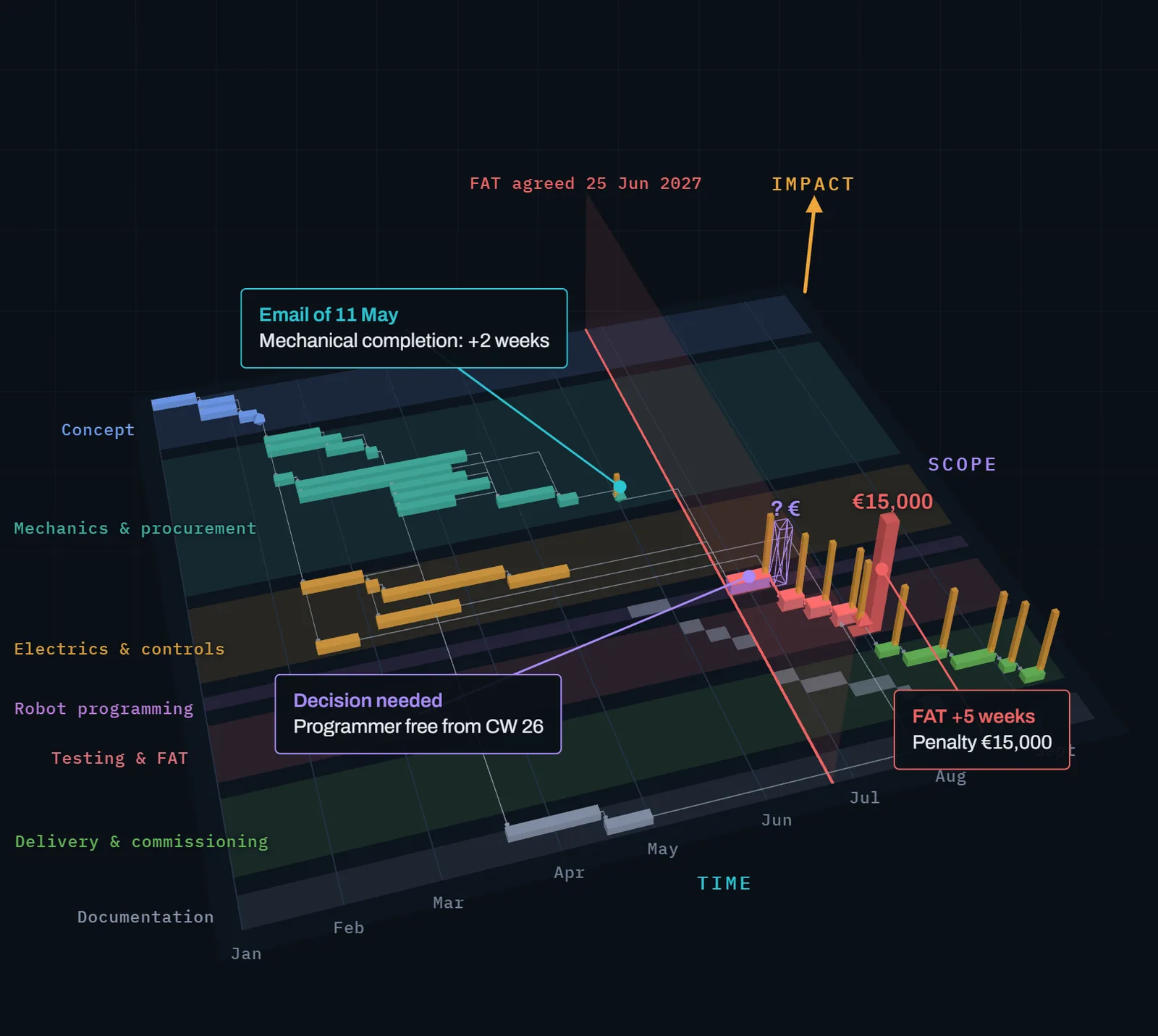
Two weeks late in assembly.Five weeks late at FAT.

AGENTT is the AI-powered living project twin for complex engineering projects. The AI reads emails, meeting minutes and quotes. You approve the changes. AGENTT calculates what they mean for schedule, scope and margin.

TIME
Schedule
SCOPE
Scope of supply
IMPACT
Consequences
  • Schedule slip
  • Cost
  • critical path
  • baseline
  • amount unknown

Worked example: robotic welding cell, contract value €600,000. 36 work packages, 46 dependencies, fictional data.

Problem

Projects change. The plan is the last to know.

In a special machine project, a change rarely arrives as a change request. It sits in a subordinate clause of an email, in a supplier’s spreadsheet, or in a two-line cancellation.

Inbox, March to May

  1. 2 MarCustomer, production planningEmail
    Please also allow for variant B in the fixture. […] We assume the deadline remains unaffected.
  2. 30 MarWelding equipment supplierEmail
    Delivery of the welding power source will be delayed by 3 weeks.
  3. 31 MarRobot manufacturerExcel
    The lead time of the robot is extended by 4 weeks.
  4. 10 MayExternal robot programmerEmail
    CW 21–22 won’t work after all, will get back to you.
  5. 11 MayProduction managerEmail
    … mechanical completion will probably slip by two weeks to CW 22.
Project-plan.xlsxlast updated 3 weeks ago
Mechanicsuntil CW 20on schedule
Robot programmingCW 21–22on schedule
Acceptance (FAT)CW 25on schedule

Five messages, none of them entered into the plan.

Scattered information

The state of the project lives in emails, PDFs, spreadsheets and people’s heads. The plan shows whatever someone last typed in.

Hidden dependencies

A slip in mechanics hits programming, testing and acceptance. That it also hits the booked external programmer is not visible in any bar.

Late consequences

Penalties, a postponed final payment and extra costs become visible when nothing can be done about them any more.

Traditional project planning manages tasks. AGENTT connects changes with their consequences.

How it works

From project documents to a project state you can rely on.

Four steps, with a person at the decisive one.

  1. 01

    Understand

    The AI reads incoming documents and picks out what matters for the project: dates, demands, cancellations, prices. It tells a question from a demand, and “probably” from “firmly confirmed”.

  2. 02

    Connect

    Every observation is linked to a work package, a resource or a contract clause. The verbatim evidence from the source stays attached.

  3. 03

    Approve

    You decide. Nothing changes the plan before a person has accepted it. Contradictions and vague statements become a query, not an assumption.

  4. 04

    Anticipate

    After approval, AGENTT recalculates dates, critical path and commercial consequences. That is arithmetic by fixed rules, not a language model’s estimate.

Time · Scope · Impact

Three dimensions. One project state.

Schedule, scope and commercials usually live in three tools. In AGENTT they are three views of the same data, flat as table and bar chart or spatial as a project landscape.

TIMEDates, milestones, dependencies and the critical path.

CW 19CW 21CW 23CW 25CW 27CW 29CW 31CW 33CW 35booked outMechanical completionRobot programming (external)Safety check, CE pre-checkInternal pre-acceptanceFAT at the manufacturerFAT completedInstallation at customer siteOn-site commissioningSATFAT agreed 25 Jun 2027
  • baseline
  • after the change
  • critical path

11 work packages moved. FAT on 30 Jul 2027 instead of 25 Jun 2027.

SCOPERequirements, scope of supply, exclusions and change requests, each with its source.

  • SC-07

    Component variant A (welded assembly, 3 seams) is welded automatically

    Requirement · Requirements spec 4.2

  • SC-12

    Fixture for exactly one component variant (A)

    Deliverable · Order confirmation, item 3

    affected
  • SC-19

    Further component variants are not part of the offer

    Exclusion · Order confirmation, exclusions

    affected
  • SC-23

    FAT at the manufacturer with customer attendance, 3-day window

    Requirement · Requirements spec 7.1

New: customer asks for variant B

Please also allow for variant B in the fixture.

Email from customer, production planning, 2 Mar 2027

Potential change order. Conflicts with SC-12 and SC-19.

Estimated extra effort: fixture +10 working days, programming +3 working days.

IMPACTCosts, revenue, liquidity and resources. Every figure has a rule or a named assumption behind it.

  • Penalty for late FAT

    0.5% of contract value per week or part thereof, capped at 5%. Contract § 9.2. Five weeks late.

    Cost€15,000
  • Final payment arrives later

    15% of contract value, due 30 days after FAT. Arrives 35 days later.

    Liquidity€90,000
  • Rebooking the robot programmer

    No rate has been agreed for extra days or rebooking. AGENTT does not put a number on it.

    Costunknown

Contract value €600,000

Example

One change. Five consequences.

A plant builder is making a robotic welding cell. On 11 May the production manager sends an email. Nothing changes in the project plan.

1Source

From
Production manager
To
Project management
Subject
Welding cell – status mechanics

11 May 2027, 16:42

Hi all, quick update from production: base frame and safety enclosure are finished. Because of rework on the fixture, mechanical completion will probably slip by two weeks to CW 22. Control cabinet is on schedule. Regards

2Detected change

Schedule

Mechanical completion slips to CW 22

mechanical completion will probably slip by two weeks to CW 22.
Work package
B120 Mechanical completion
New finish
4 Jun 2027 (end of CW 22)
Shift
+10 working days
Certainty
vague (“probably”)
Why it matters
Milestone before robot programming

Only your approval changes the project state.

3Project twin

State: baselineState: after approval

  1. Mechanics complete

    21 May 20274 Jun 2027

    +10 working days

  2. Robot programming

    from 24 May 2027from 28 Jun 2027

    The booked slot can no longer be kept.

  3. External programmer

    booked CW 21–22free from CW 26

    Query answered: available again from 28 Jun 2027.

  4. Acceptance (FAT)

    25 Jun 202730 Jul 2027

    11 work packages moved; 25 Jun 2027 was agreed.

  5. Commercial consequences

    nonePenalty €15,000

    Final payment of €90,000 arrives 35 days later. Rebooking cost: unknown.

Fictional demonstration example. Dates and amounts are calculated by the prototype’s calculation engine.

Technology and data

Your projects. Your data. Your decision.

Contracts, drawings and costings are the most sensitive things a machine builder owns. AGENTT’s architecture starts from that.

Local first

AGENTT is designed to run on your own hardware. Project documents do not have to leave the building. An external model can be switched on for individual tasks, as a deliberate choice rather than a requirement.

Model-independent

The architecture is not tied to a particular AI model, inference runtime or chip vendor. Models are connected so that they can be swapped.

Traceable

Every detected change points to the passage it came from. Every decision is in the history with date and person. Every figure leads back to a rule or an assumption.

The AI reads. The numbers are calculated without it.

The language model reads documents and makes proposals. Dates and amounts come from a deterministic engine that returns the same result for the same inputs. What is not known stays marked as unknown.

Language model readsYou approveEngine calculatesevery result leads back to its source

Where we are today

Calculated
Schedule and impact calculation run in the prototype and are checked against six reference scenarios of the example project.
Visible
The 3D project landscape above shows this prototype’s data model, not an illustration.
Next step
Analysing real project documents with local AI, together with pilot partners.

Pilot partners

Looking for pilot partners.

We are looking for companies in special machine building, plant engineering and automation who want to try the project twin on a project of their own and have a say in what it needs to do.

  1. 01You bring a running or completed project.
  2. 02Together we model it as a project twin and check which changes it detects.
  3. 03You help decide what AGENTT has to do first.

We use your details only to answer your request. More in the privacy notice.